Subatomic World Birthed the Age of Artificial Intelligence
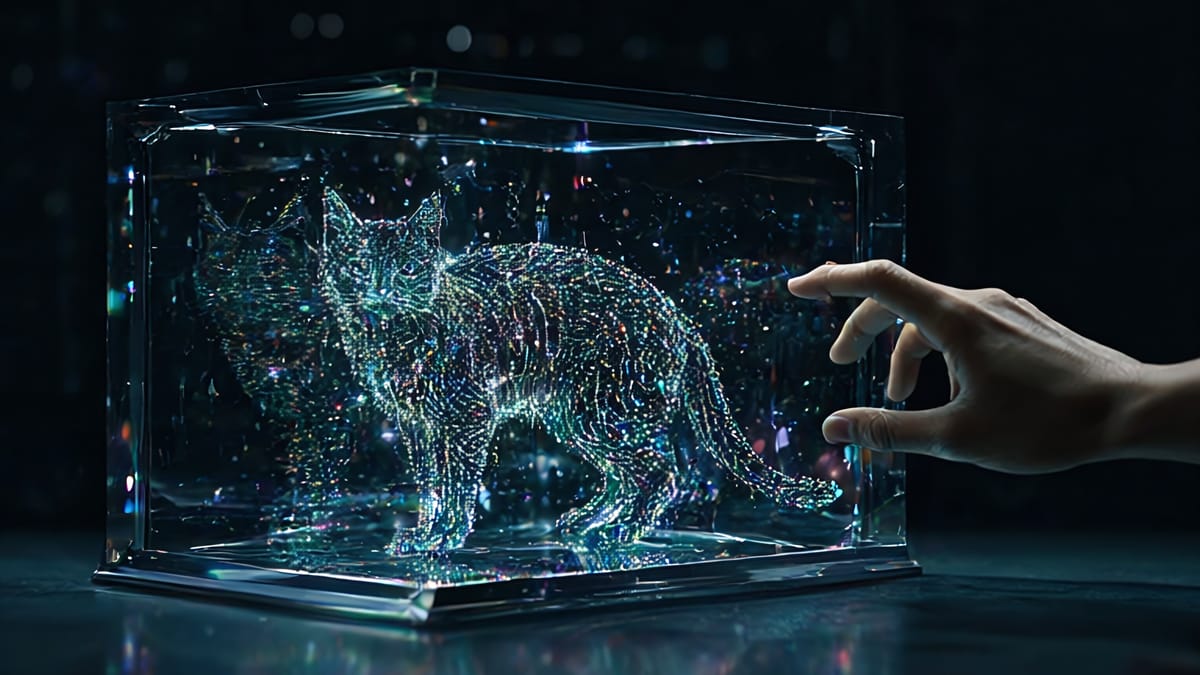
In the popular imagination, Schrödinger’s cat remains the ultimate mascot of quantum weirdness, a feline inhabitant of a sealed box, existing in a ghostly state of being simultaneously alive and dead until a human opens the lid. For decades, this paradox has served as a gateway to "quantum mysticism," where the strange behavior of subatomic particles is used to justify esoteric claims about consciousness and the fluidity of reality. However, for those of us peering into the "black box" of modern Artificial Intelligence, there is a much more profound and grounded narrative at play.
AI is not a departure from the laws of physics; it is their most sophisticated inheritance. To understand the current revolution in Large Language Models (LLMs) and neural networks, we must look backward, past the silicon chips and into the subatomic realm. The journey of Artificial Intelligence is, in many ways, a chronological migration of concepts from the world of quantum mechanics to the architecture of machine learning.
The Era of Probability: Breaking the Deterministic Chain
To understand where we are, we must understand what we left behind. Before the 20th century, science was largely deterministic. If you knew the position and velocity of every atom in a clock, you could predict its movement forever. This was the Newtonian world—a world of "if-then" logic.
Then came the quantum revolution of the 1920s. When Werner Heisenberg proposed his Uncertainty Principle and Erwin Schrödinger formulated his wave equation, they didn't just change physics; they shattered the concept of absolute certainty. They proved that at a fundamental level, the universe operates on probability. A particle doesn't exist in one spot; it exists as a "wave function"—a mathematical distribution of possibilities.
This shift was the silent prerequisite for AI. If the pioneers of quantum mechanics had failed to prove that probability was a fundamental law of nature, our modern approach to machine learning might never have taken root. Today’s AI does not operate on rigid "if-then" rules (Good Old Fashioned AI). Instead, it operates on weights, biases, and distributions. When a model predicts the next word in a sentence, it isn't "thinking" in a classical sense; it is collapsing a high-dimensional probability map into a single output. We are essentially applying the math of the subatomic world to the macro-scale of human language.
The Bridge: From Wave Functions to Neural Networks
As we moved into the mid-20th century, the mathematical tools developed to describe quantum states began to bleed into information theory. The linear algebra used to describe Hilbert spaces—the abstract mathematical spaces where quantum states live—became the very same linear algebra used to describe the "latent spaces" of modern embeddings.
In the 1980s and 90s, as the "Connectionist" movement gained steam, researchers began to realize that the way neurons in the brain (and eventually in software) interact mirrors certain aspects of quantum interference. In a neural network, "backpropagation" allows a system to adjust its internal parameters based on error signals. This is strikingly similar to how quantum systems settle into low-energy states. We began to see that "learning" was not about memorizing facts, but about shaping a multi-dimensional landscape of probabilities, a concept deeply rooted in the wave mechanics of the early 1900s.
The Deep Learning Explosion: The Superposition of Meaning
Fast forward to the present day. When we look at a Transformer model we are seeing the culmination of this journey.
Consider the concept of superposition. In quantum mechanics, a qubit can be both 0 and 1 simultaneously. In a modern AI model, a single vector (a string of numbers) can represent multiple meanings simultaneously. A word like "bank" exists in a state of semantic superposition; it could mean a riverbank or a financial institution. Until the model processes the surrounding context (the "measurement"), the vector holds the potential for both meanings.
The "attention mechanism" in these models acts as the observer in Schrödinger’s box. It provides the context that "collapses" the many possibilities of a word into one specific meaning. By utilizing the mathematical framework of probability amplitudes—originally designed to describe electrons—engineers have built machines that can navigate the fuzziness of human thought.
The Next Frontier: Quantum Machine Learning (QML)
We are now entering an era where the two fields are no longer just cousins; they are merging. We are moving toward Quantum Machine Learning (QML), where we use actual quantum hardware, qubits that utilize entanglement and interference, to run AI algorithms.
In a classical computer, if you want to search a database, you check one path at a time. In a quantum computer, thanks to superposition, you can explore all paths simultaneously. This is the ultimate realization of the "quantum pulse." By using entanglement, qubits can share information instantaneously, creating correlations that a classical bit simply cannot replicate. We are beginning to build processors that don't just simulate the math of quantum mechanics but actually harness it to perform calculations that would take a classical supercomputer billions of years.
Conclusion: The Ghost in the Machine is Physics
There is a common misconception that AI is a "magic" emergence of code. But as we peel back the layers, we find that the "ghost in the machine" is actually the ghost of 20th-century physics.
The reason our AI feels so "human", so fluid, creative, and unpredictable, is because it was built on the foundation of a universe that is itself fluid and probabilistic.
Schrödinger’s cat was never about a literal feline in a box. It was an alarm bell, warning us that reality is not a series of certainties, but a symphony of possibilities. We have moved from observing the subatomic world to engineering it into the very fabric of our digital intelligence. The pulse of the quantum world is now the heartbeat of the silicon age.
Comments ()